
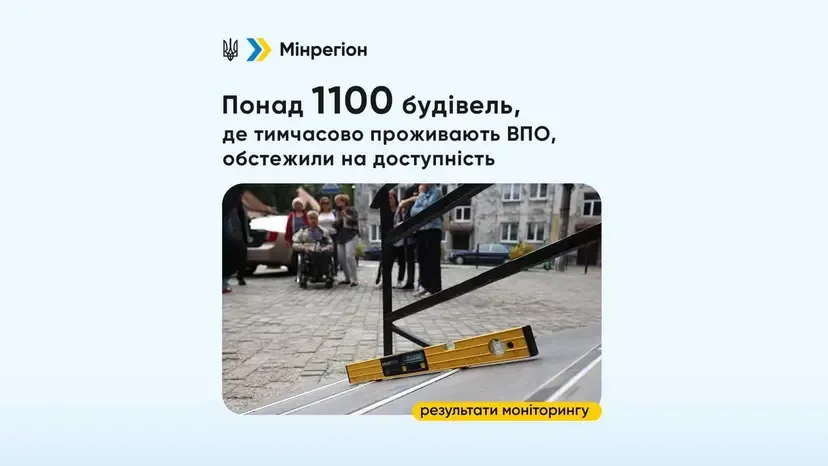
Modular housing complexes and social housing were found to be the most accessible, while the greatest number of barriers was recorded in dormitories.
The Ministry of Regional Development initiated a monitoring effort on the accessibility of temporary housing for internally displaced persons (IDPs), in which 484 communities across 22 regions participated. A total of 1,108 buildings, housing more than 50,000 people, were surveyed. The goal of the monitoring is to identify the main barriers and measures that will help make these buildings more accessible.
The monitoring revealed that nearly 700 buildings are fully or partially accessible to people with disabilities and other mobility-impaired groups. Meanwhile, about 400 are inaccessible, and their accessibility requires further attention.
The highest rates of housing accessibility were recorded in Kirovohrad (48%), Khmelnytskyi (44%), and Dnipropetrovsk (39%) regions. In contrast, the lowest rate was in the Chernihiv region, where only 4% of the surveyed buildings are accessible.
Among the most common barriers are the lack of tactile signs and accessible universal restrooms. The issue of restroom accessibility is particularly pressing: 42% of IDPs with disabilities live in buildings that lack an accessible restroom.
The survey results will help identify where and what changes need to be made first. This will allow efforts to be focused on the most problematic facilities and improve living conditions for residents.