

Under the leadership of Deputy Prime Minister for Reconstruction Oleksiy Kuleba, the Ministry of Development and Reform continues to formulate state policy on temporarily occupied territories and coordinate evacuation measures.
The main goal is not just to respond to challenges, but to ensure full consistency of decisions and act proactively for the sake of people’s safety. Deputy Minister Oleksiy Ryabykin directly coordinates this direction.
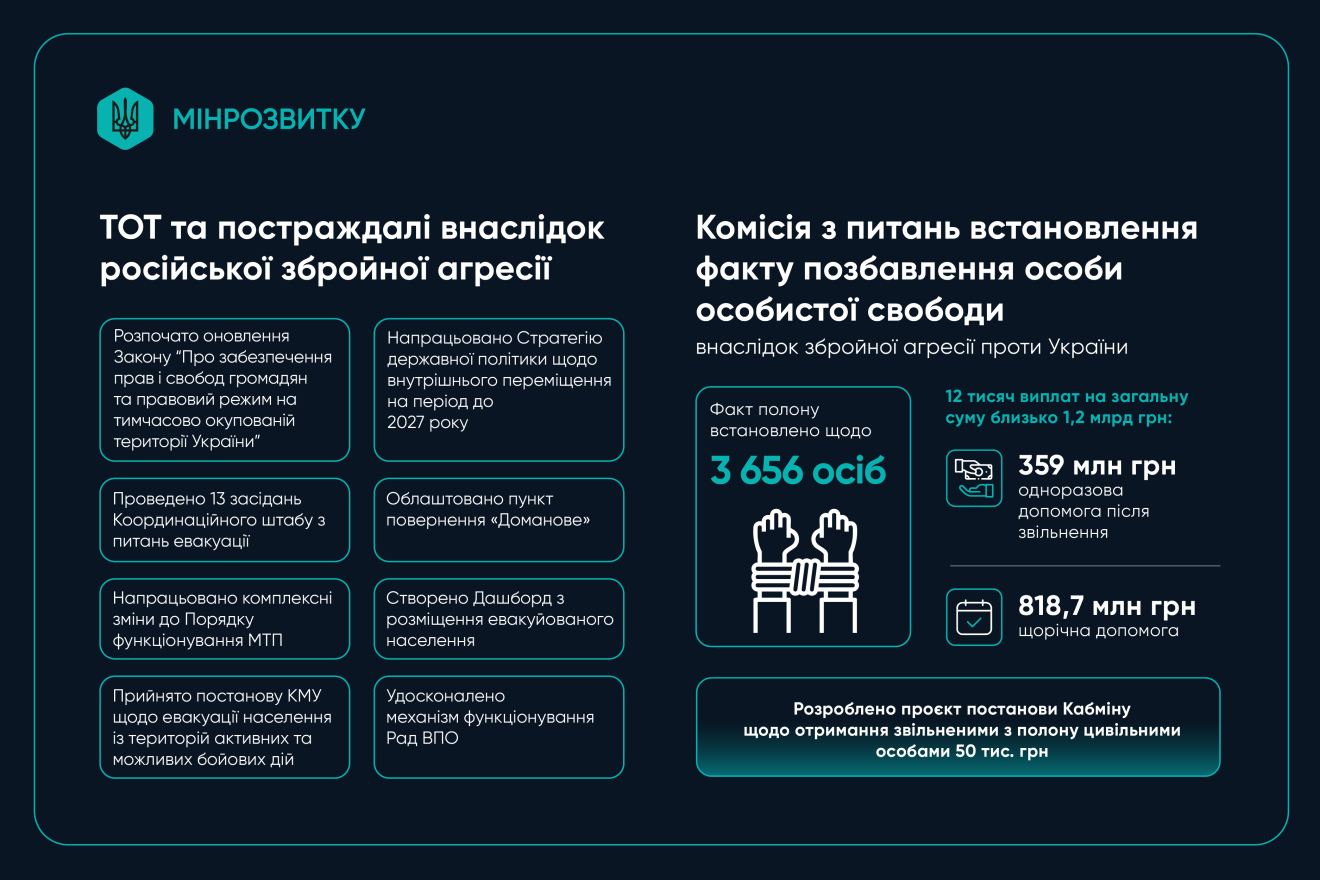
In 2025, the Law of Ukraine “On Ensuring the Rights and Freedoms of Citizens and the Legal Regime in the Temporarily Occupied Territory of Ukraine” was updated. A relevant Working Group was created – 4 meetings have already been held. A Working Group on the Activities of Municipal Enterprises in Frontline and Temporarily Occupied Territories of Ukraine is also operating.
Evacuation Measures and Policies for IDPs
The Ministry of Development and Reform ensures the organized relocation of the population from dangerous zones. To this end, the Evacuation Coordination Headquarters is actively working, having already held 13 meetings, promptly adjusting routes depending on the security situation and the capabilities of communities.
The Ministry of Development and Reform is implementing a comprehensive approach “Evacuation Path”, which provides for full support for a person: from the moment of leaving home to safe accommodation. This process is legally regulated by updated Government resolutions so that bureaucratic procedures do not get in the way of saving lives.
Currently, 21 transit centers are operating in Volyn, Dnipropetrovsk, Zaporizhia, Sumy, Kharkiv and Kherson regions. Evacuees are met there by multidisciplinary teams of social workers, doctors, lawyers and psychologists, who provide first aid, register and provide support.
At the initiative of the Ministry of Development and Reform, a Dashboard for the placement of the evacuated population has been introduced, which provides information on available free places for temporary settlement. This issue is currently under the control of the Ministry of Social Policy, Family and Unity.
In parallel, the Ministry of Development is improving the work of IDP Councils and preparing an updated, more human-centered Procedure for the functioning of temporary residence places, which is planned to be approved in the first half of 2026. Comprehensive changes to the rules of residence in temporary settlement places have also been developed. We expect that the updated Procedure for the functioning of the ICC will be approved by the Government in the first half of 2026.
Together with international partners — the UN, IOM and the Council of Europe — a State Policy Strategy on Internal Displacement until 2027 has been developed. This is a fundamental document that covers all stages in the life of IDPs: from evacuation and provision of temporary housing to retraining, employment and full integration into new communities.
Support for citizens who are in temporary detention or illegally deprived of their liberty
A separate priority remains the support of citizens who are in temporarily occupied territories or have been illegally deprived of their liberty. At the Domanovo checkpoint, appropriate conditions have been created for the meeting of our citizens: basic support is provided, information has been established, and comfortable accommodation for people in case of a long wait to cross the border has been organized.
Another step towards supporting the victims was the development of the project “On Approval of the Procedure for Carrying Out Priority Measures to Support Civilians Victims of Deprivation of Personal Freedom as a Result of Armed Aggression Against Ukraine”. The document provides for a mechanism for priority financial support for such citizens in the amount of 50 thousand hryvnias.
Key plans for the coming year
The plans for 2026 include further improvement of the regulatory framework for occupied and frontline territories, training regional administrations in effective evacuation methods, and approval of the Transitional Justice Concept.
Important steps will be a large-scale information campaign on the operation of the 15-48 hotline, as well as the restoration of historical justice through the development of a mechanism for payments to Ukrainians forcibly evicted in 1944–1951.