

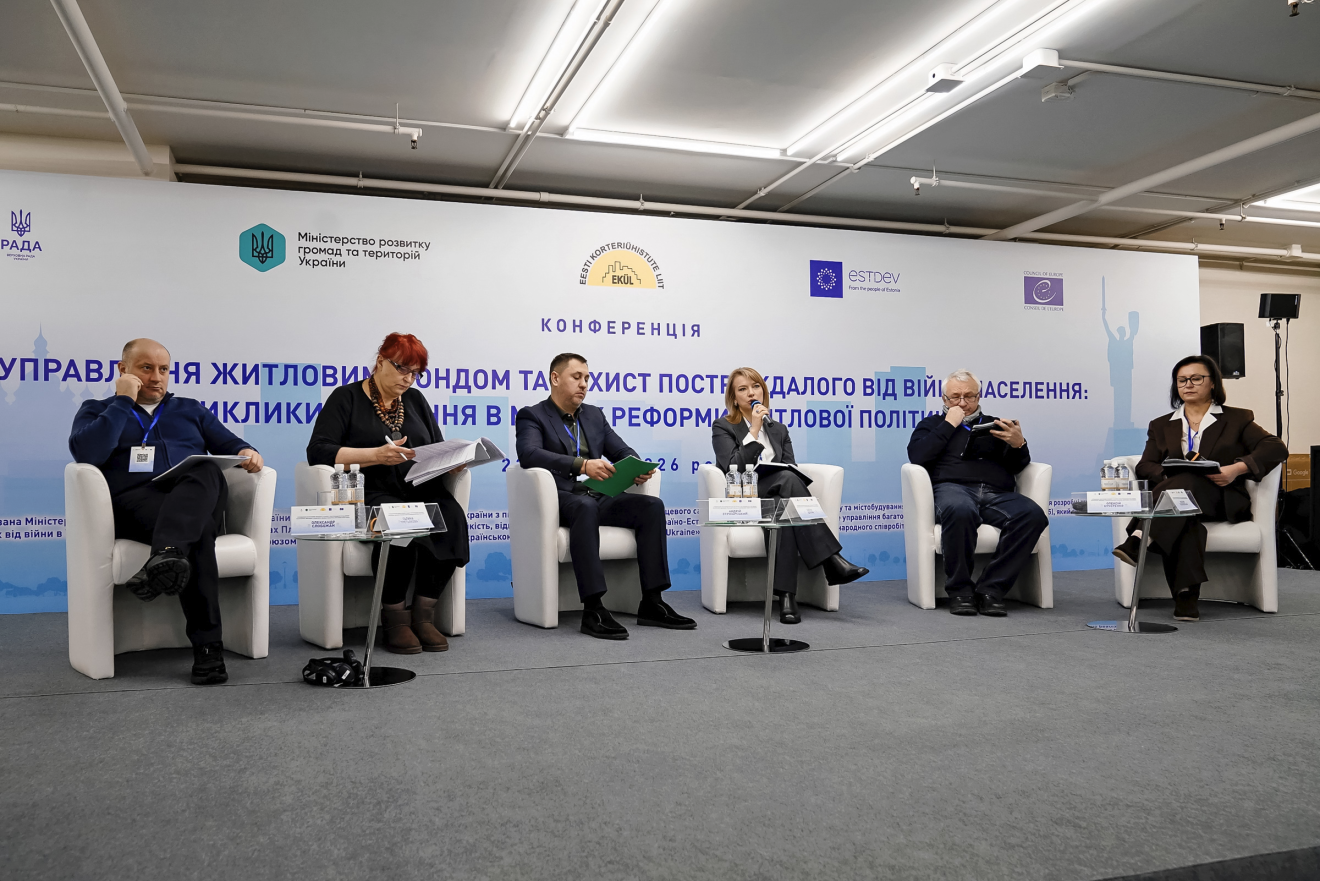
Deputy Minister of Community and Territorial Development of Ukraine Natalia Kozlovska presented the draft law “On Housing Management.” The document is one of the key elements of housing policy reform and is intended to address current challenges and long-standing problems in the field of housing management. The proposals were also developed in close cooperation with relevant associations of condominium owners and housing managers. The presentation took place during the conference “Housing Stock Management and Protection of War-Affected Populations: Challenges and Solutions within the Framework of Housing Policy Reform.” The event brought together Ukrainian MPs, representatives of the Council of Europe and other international organizations, experts in the field of housing policy, representatives of professional associations of housing managers, and civil society organizations.
During her speech, Nataliia Kozlovska recalled that on February 12, 2026, the President of Ukraine signed the Law “On the Fundamentals of Housing Policy” — the first and main document in the housing reform system.
According to her, the next steps should be the adoption of laws on social housing and housing stock management.
“We need to change our focus: today, the main thing is not just the operation of buildings, but the preservation of housing. Professional management should become the norm for every building. It is effective management that can ensure the longevity of the housing stock, regardless of its purpose or form of ownership,” Natalia Kozlovska emphasized.
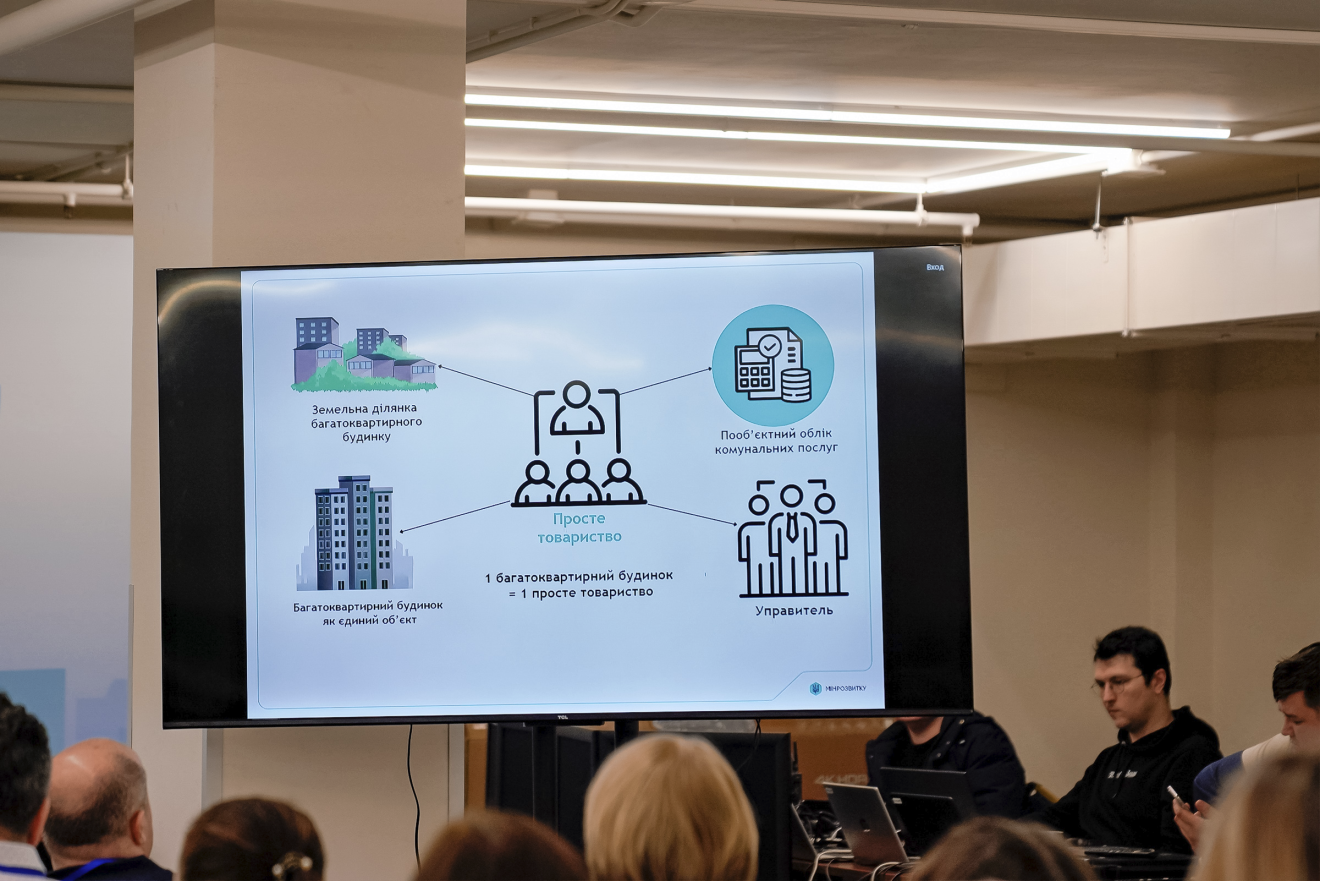
The main innovation of the future law is that each apartment building (except those where a condominium association has already been established) must have its own legal entity—a simple co-owners’ association. It will represent the interests of residents and help organize building management.
“This is a new legal entity that will be automatically created for each apartment building if there is no condominium association and will represent the interests of all co-owners. Its founders will be the owners of apartments and non-residential premises in the building, and it will act on their behalf. In fact, it will be the ‘official representative’ of the building,” said Natalia Kozlovska.
It is planned that the building itself, auxiliary structures, and the land plot under it will be assigned to the co-owners’ association. Such an organization will be responsible for common issues of residents: accounting for utilities for the needs of the building (for example, lighting of entrances or operation of elevators), choosing the form of management, and concluding an agreement with the manager.
Separately, future changes regarding the adjacent territories and land plots on which apartment buildings are located were also presented. The draft law provides that the land under and around the building will be legally linked to the building itself and will belong to its co-owners, regardless of whether an OSBB has been created or the building is managed by another structure.
In particular, it is proposed to allocate such plots to a separate category of “multi-apartment building land” and automatically register the rights to them after the building is put into operation, as well as to simplify all the necessary procedures for this. The owners of the land will be determined by the co-owners of the building (through the condominium association or another authorized legal entity). At the same time, it will be prohibited to sell such land or change its purpose.
Among other things, the future law should solve one of the biggest problems for condominium associations and managers—interaction with large utility providers. The draft law proposes to clearly define that condominium associations and new co-owners’ associations will be considered residential consumers — that is, they will pay at rates for the population, not as businesses. This applies primarily to electricity and natural gas for rooftop boiler rooms.
“This is critically important, because today every apartment owner is effectively left alone with service providers and has almost no opportunity to defend their interests. However, after the creation of a condominium association or a simple co-owners’ association, co-owners can interact with suppliers on behalf of the entire building, which significantly strengthens their position,” the Deputy Minister expressed her confidence.
The authors of the bill also propose to solve the widespread problem of non-compliance with technical conditions in new buildings, which residents of many cities in Ukraine face. This refers to situations where buildings are put into operation without being fully connected to the necessary utility networks. It is proposed to establish clear and understandable deadlines for the transfer of new buildings after commissioning, with mandatory connection to all utilities.
Key changes proposed by the draft law
The document provides for a comprehensive update of the rules for housing management in Ukraine. In particular, it proposes:
to introduce clear rules for the management of any housing, regardless of its legal status;
create a legal entity for each apartment building (if there is no condominium association) to represent the interests of co-owners;
form a single register of apartment building management and a management system that will become part of the Unified Information and Analytical Housing System.
create a complete database of the housing stock of each community with information about all buildings;
regulate the status of condominium associations and managers as consumers of utility services for the needs of the building;
establish clear professional requirements for managers;
clearly delineate responsibilities between co-owners, condominium associations, and managers.
Following the meeting, the document will be submitted to the parliamentary committee on the organization of state power, local self-government, regional development, and urban planning for further refinement and consideration by the Verkhovna Rada.
The conference was organized by the Ministry of Community and Territorial Development of Ukraine in conjunction with the Verkhovna Rada Committee on Organization of State Power, Local Self-Government, Regional Development, and Urban Planning, with the support of the Council of Europe Project “Promoting Housing Solutions for People Affected by the War in Ukraine. Phase II,“ implemented within the framework of the Council of Europe Action Plan for Ukraine ”Resilience, Recovery and Reconstruction” 2023-2026, the Ukrainian-Estonian project “Together for Effective Management of Multi-Apartment Buildings in Ukraine” (TEAM 2025), which is jointly implemented by the Estonian Union of Housing Cooperatives (EKYL) and the All-Ukrainian Public Organization “Housing Ukraine” with the support of the Estonian Center for International Cooperation (ESTDEV).